
The Daily Routine That Made Our Childcare Days Calmer, Not Just Busier
I used to think a good day at childcare just meant keeping kids busy. Fill the hours, check the boxes, send them home tired. It took me longer than I'd like to admit to realise that busy and balanced are two very different things. This daily schedule template came out of a lot of trial and error. Too much structured learning in the morning and the kids are burnt out by snack time. Not enough outdoor play and everyone gets cranky by noon. Skip the wind-down before nap and good luck getting anyone to actually sleep. The order of things matters just as much as the things themselves.
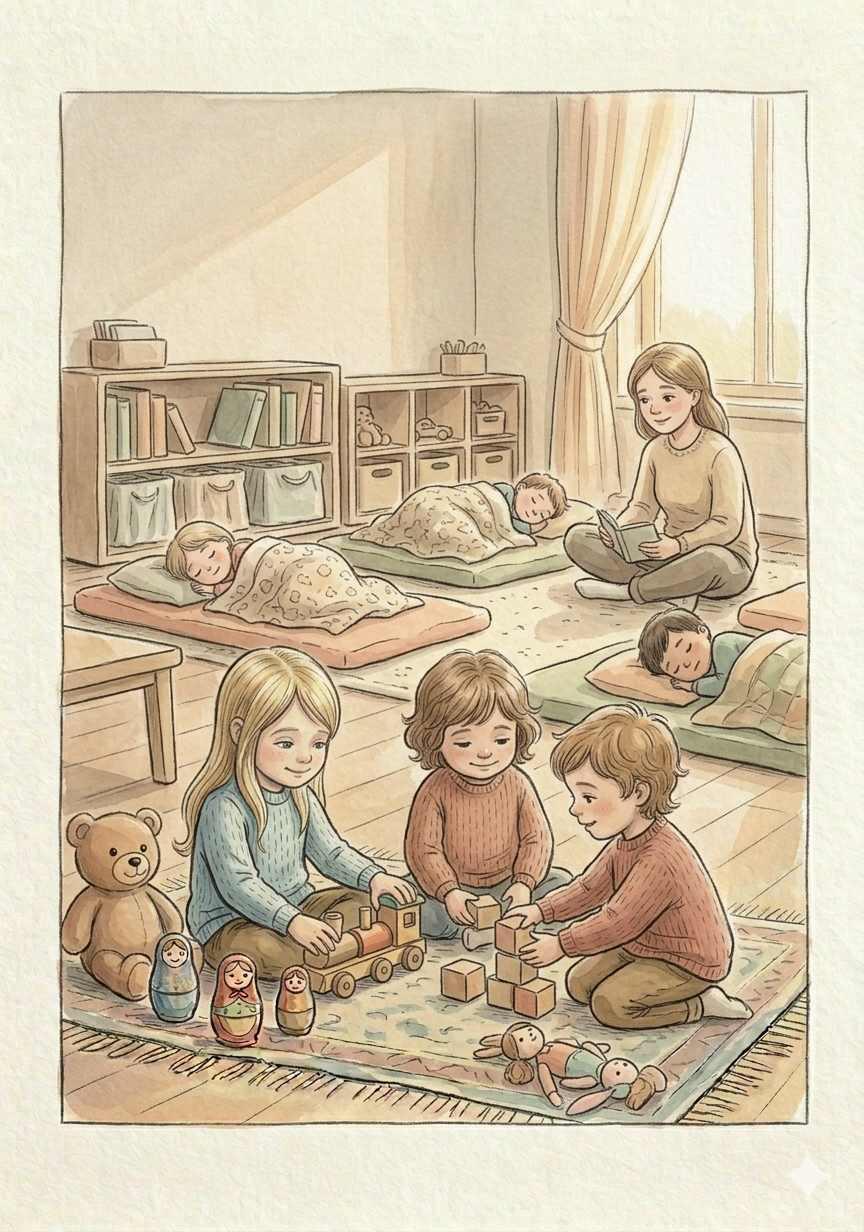
How I Plan a Balanced Day at Childcare (And Why the Order Actually Matters)
I used to think a good day at childcare just meant keeping kids busy. Fill the hours, run the activities, send them home tired. Job done. It took me longer than I'd like to admit to figure out that busy and balanced are two completely different things, and that I'd been confusing one for the other for a while.
The shift happened on a Tuesday, of all days. We'd had a morning packed with structured activities, one after another, literacy then numeracy then a craft project, and by the time we got to lunch the kids were done. Not tired in a good way. Done in that frayed, overstimulated way where everything becomes a negotiation and someone always ends up crying over the wrong colour cup. I looked at my schedule that day and thought, we did everything right on paper. Why does this feel so wrong?
That was the question that started everything. And the answer, when I finally found it, was embarrassingly simple. It wasn't what we were doing. It was the order we were doing it in, and whether we were actually giving kids enough time in each part of the day to settle in, engage, and then let go before moving on to the next thing.
Kids this age, roughly two to five, don't operate the way we sometimes expect them to. They're not small adults who can power through a full morning of brain work and then switch into play mode on command. Their nervous systems don't work like that. There's a real, physical energy curve to their day, and once I started building the schedule around that curve instead of against it, everything got quieter. Calmer. More like what I'd always imagined childcare could feel like.
So here's what I've learned about how that curve actually works.
Kids arrive buzzing. Even the ones who were glued to their parent's leg at drop-off yesterday walk in with something different the next morning. A little readiness. A little curiosity. That first half hour should meet them there, not rush them past it. It's the time for settling, for reconnecting with the space and the people in it, for choosing something familiar and comfortable. Free choice play in the morning isn't a warmup. It's actually doing something important for their sense of safety and belonging.
By mid-morning, maybe around nine or nine thirty, that's when you've got the real window. Energy is up, bellies are settled from breakfast, and kids are genuinely ready to engage with something that asks a little more of them.
That's your circle time, your structured activity, your literacy or numeracy focus. Not because the curriculum says so, but because that's when their brains are actually open for it.
Then comes outdoor play, and I can not overstate how much this matters. It's not a break from the day. It is part of the day. Running, climbing, digging, arguing over who gets the red bike, all of it is building something real. Gross motor skills, obviously, but also problem-solving, negotiation, risk assessment, and resilience.
A child who has spent forty-five minutes outside comes back in a completely different state to one who hasn't. More regulated, more ready, more themselves.
Lunch sits right in the middle of the day for a reason. It's a natural full stop. After lunch, the body wants to rest, and fighting that with another round of activities is just making your afternoon harder than it needs to be. Wind down, dim the lights a little, put on something soft, let the room change its mood.
Then nap time, or quiet rest for the ones who've outgrown sleeping. That block of stillness in the middle of the day is non-negotiable for this age group, even when parents tell me their child doesn't nap anymore.
Put them on a mat with a book and soft music and nine times out of ten they're asleep within twenty minutes. Their bodies know what they need even when they're convinced they don't.
The afternoon has its own rhythm too. Kids wake up slowly, they need a snack, they need some time to find themselves again.
This is actually one of my favourite parts of the day if you let it be. There's a gentleness to the afternoon that the morning doesn't have.
Sensory play, messy play, creative exploration, this is when kids go deep into something without the pressure of a structured outcome. Afternoon is not the time to introduce new concepts. It's the time to consolidate, to play freely, to be.
And then pickup. Which has its own energy entirely, somewhere between excitement and exhaustion, and the best thing you can do is make it calm and predictable.
Pack up together, do a little reflection, let kids feel that the day had a shape and they were part of it.
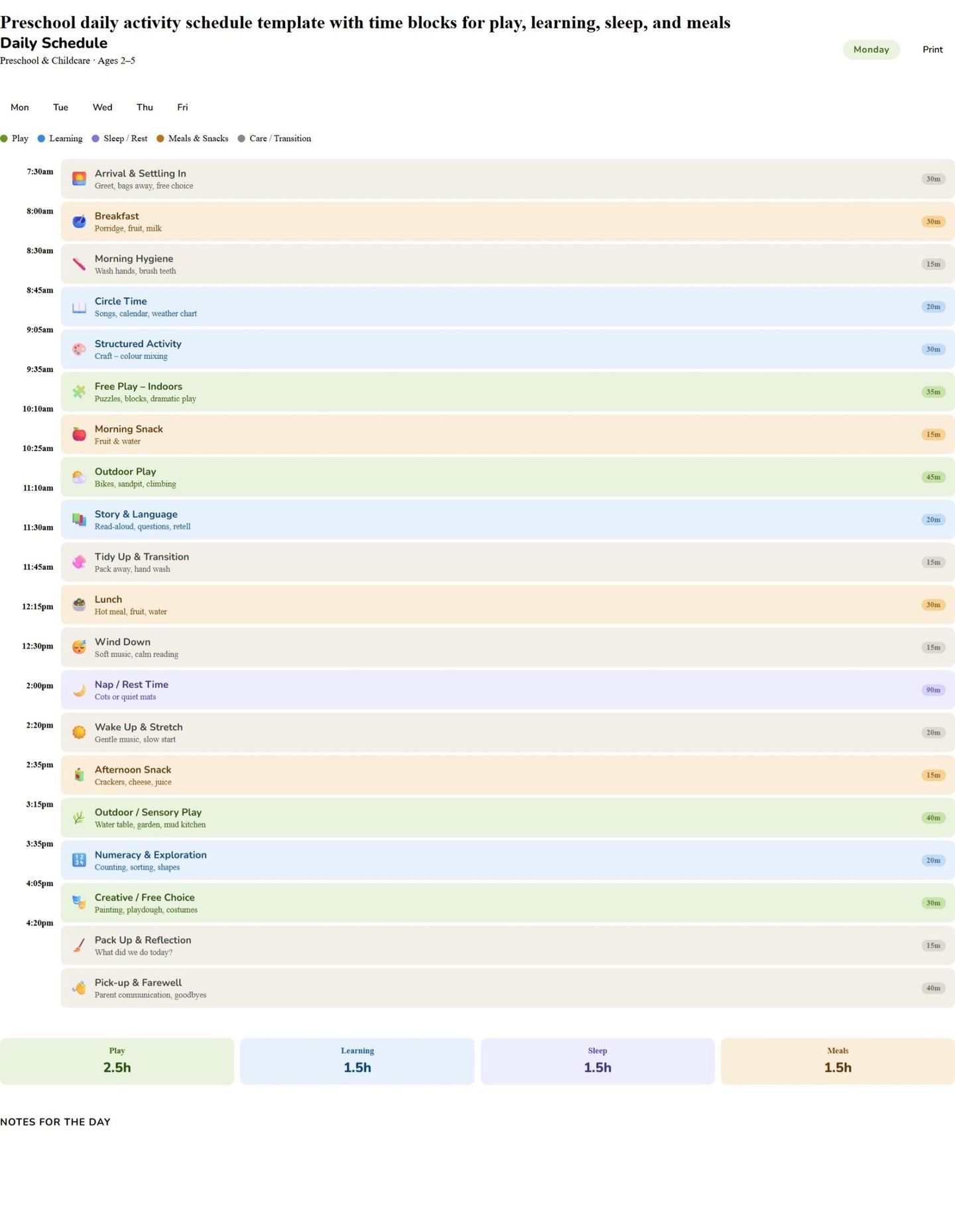
That's the skeleton of every day in this template. Five full days, Monday through Friday, each one a little different so the week doesn't become one long repetitive loop, but all of them built around the same underlying rhythm. The activities rotate. The structure stays.
I also made sure each day has a clear visual balance across four categories, play, learning, rest, and meals. That's the color coding in the template. Green for play, blue for learning, purple for sleep and rest, amber for meals and snacks.
The reason I did it that way is that it's very easy to look at a written schedule and think it seems balanced, and then actually map it out visually and realise learning has taken over the whole morning and play is squeezed into two twenty-minute gaps. The colors make it honest. If a day looks mostly blue, something needs to shift.
Play gets undervalued constantly in early childhood settings, and I think it's because it doesn't look like learning from the outside. A group of four-year-olds negotiating the rules of an imaginary bakery looks like messing around.
It is actually language development, mathematical thinking, social problem-solving, emotional regulation and creative reasoning all happening at once. It just doesn't produce a worksheet at the end of it.
The templates are printable. You can stick them on the wall, put them in a folder for relief educators, hand them to parents who want to know what the day looks like, or just use them as a planning base to build your own version from.
Every centre is different, every group of kids is different, and the best schedule is always the one that's been adapted to the actual humans you're working with.
But the bones of this one are solid. And they come from a lot of Tuesdays that went wrong before the good ones started to stick.