
The Lesson Plan Template I Wish I Had in My First Year of Childcare
If you have ever stared at a blank planning folder on a Sunday night with a week starting in twelve hours, this is for you. A free printable lesson plan template built for preschool and childcare educators, covering the full planning cycle from weekly observations and inquiry threads through to end of week reflection. EYLF aligned, honestly designed, and actually useful in a real room.
Why I Stopped Writing Lesson Plans From Scratch (And Built This Instead)
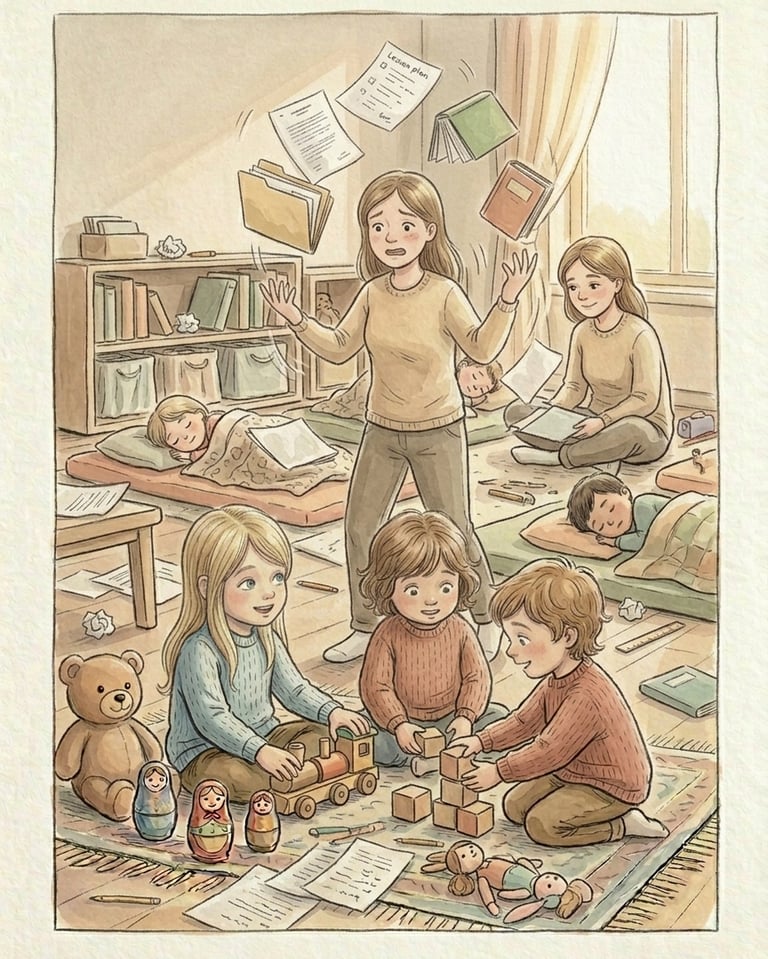
There was a point, maybe six months into my second year running a room of three and four year olds, where I opened my planning folder on a Sunday night and just stared at it. Blank pages. A week starting in less than twelve hours. And I had nothing written down because I'd spent the whole week actually in the room, doing the work, and somewhere between Thursday's painting disaster and Friday's impromptu frog-finding expedition in the garden, the planning had just not happened.
That's the thing nobody really talks about when you're training to work in early childhood. They teach you the theory. They give you Vygotsky and Piaget and a lot of very earnest lectures about play-based learning. And then you actually get into a room with fifteen three-year-olds and you realise that the gap between theory and Tuesday morning is enormous.
Lesson planning felt like the thing I was always behind on. Always catching up. Always writing last week's observations while trying to plan next week's activities while also watching to make sure nobody ate the playdough.
So I started building templates. Not because I read somewhere that templates were the answer, but because I was desperate and desperate people get creative.
The first version was terrible. Just a grid I made in Word, seven columns for the days, rows for different learning areas, and it looked organised but it didn't actually help me think. I was filling boxes for the sake of filling boxes. Literacy: books and letter sounds. Maths: counting and sorting. Done. Except none of it connected to what the kids were actually interested in, what they'd been doing that week, what questions they'd been asking. It was planning in the abstract. Planning for a generic group of children who didn't exist.
The shift came when I started reading more carefully about emergent curriculum, specifically the work coming out of Reggio Emilia in Italy, where the idea is that the child's interests and questions should actually drive the learning. Loris Malaguzzi, who founded the Reggio approach, talked about children having a hundred languages, a hundred ways of thinking, exploring, expressing. The job of the educator isn't to fill children with knowledge. It's to listen carefully enough to know what they're already reaching for, and then build toward that.
That reframed everything for me. The lesson plan wasn't a list of things I was going to teach. It was a record of what the children were curious about, and a rough map of how I was going to follow that curiosity somewhere useful.
So I rebuilt the template around that idea.
The new version had a section at the top I called "what I noticed this week." Just observations. Things kids said, questions they asked, what they kept coming back to during free play. One week it was dinosaurs, obviously, it's almost always dinosaurs at some point, but specifically it was the question of whether dinosaurs could swim. A four year old named Eli had asked it on Monday and by Wednesday half the room was invested in the answer. That one observation became the thread for an entire week of learning. We looked at books, we did a floating and sinking experiment, we drew what we thought an underwater dinosaur might look like. It hit science, literacy, art, and more conversation and language development than any structured language session I'd ever planned.
None of that would have happened if I was still filling boxes.
The template also has a section for intentional teaching, which I want to be clear is different from structured lessons. Intentional teaching, and this is a term used a lot in the Early Years Learning Framework here in Australia, means that even in play-based environments, educators are making deliberate decisions about when and how to extend children's thinking. You're not just letting kids do whatever. You're watching, and you're stepping in at the right moment with the right question or the right resource. The EYLF describes it as "educators being deliberate, purposeful and thoughtful in their decisions and actions." That sentence is now basically tattooed on my brain.
So the template has a column for intentional teaching moments. Not scripted interactions, just prompts I write to myself. If the kids are at the water table, I might write "ask them what they think will happen if we add more water" or "introduce the word 'overflow' when it happens." Small things. But writing them down means I actually do them instead of just standing nearby and watching.
The challenge I kept running into, even with the better template, was documentation. Every quality framework wants evidence. Evidence that you're observing children, planning from those observations, implementing activities, and then reflecting on whether it worked. That cycle, observe, plan, implement, reflect, sounds very clean and logical when you write it in a textbook. In practice it means you're trying to photograph a child having a breakthrough moment with one hand while stopping another child from pouring sand into someone's shoe with the other.
I started keeping a tiny notebook in my apron pocket. Just for jottings. A word, a phrase, a quote from a child. Nothing formal. And then at the end of each day, maybe ten minutes before I left, I'd transfer the best ones into the template. That ten minutes became the most valuable ten minutes of my planning week. Because it meant that by Sunday night, I wasn't staring at a blank page. I had a page full of threads to pull.
The template I've put together and shared here is built around that whole process. There's a space for weekly observations, a section for planned activities mapped loosely against learning areas, a column for intentional teaching prompts, and a reflection box at the end of the week. It's not prescriptive. It doesn't tell you what to teach. It gives you a structure to think inside of, which is a different thing entirely.
The research backs this up pretty clearly. A 2015 study published in Early Childhood Education Journal found that when educators used structured but flexible planning frameworks, as opposed to rigid lesson plans, children showed higher levels of engagement and more complex play behaviours. Flexible structure, not no structure. That distinction matters.
And honestly, the other thing it does is protect you. When a director asks why you spent three days on dinosaurs, you have documentation. You have the observation that started it, the learning outcomes it connected to, the reflection that shows what the children got from it. You're not just saying "the kids were into it." You're showing the professional thinking behind every decision.
That's what good planning actually is. Not a list of activities. A record of how you thought about children, and what you did with what you saw.
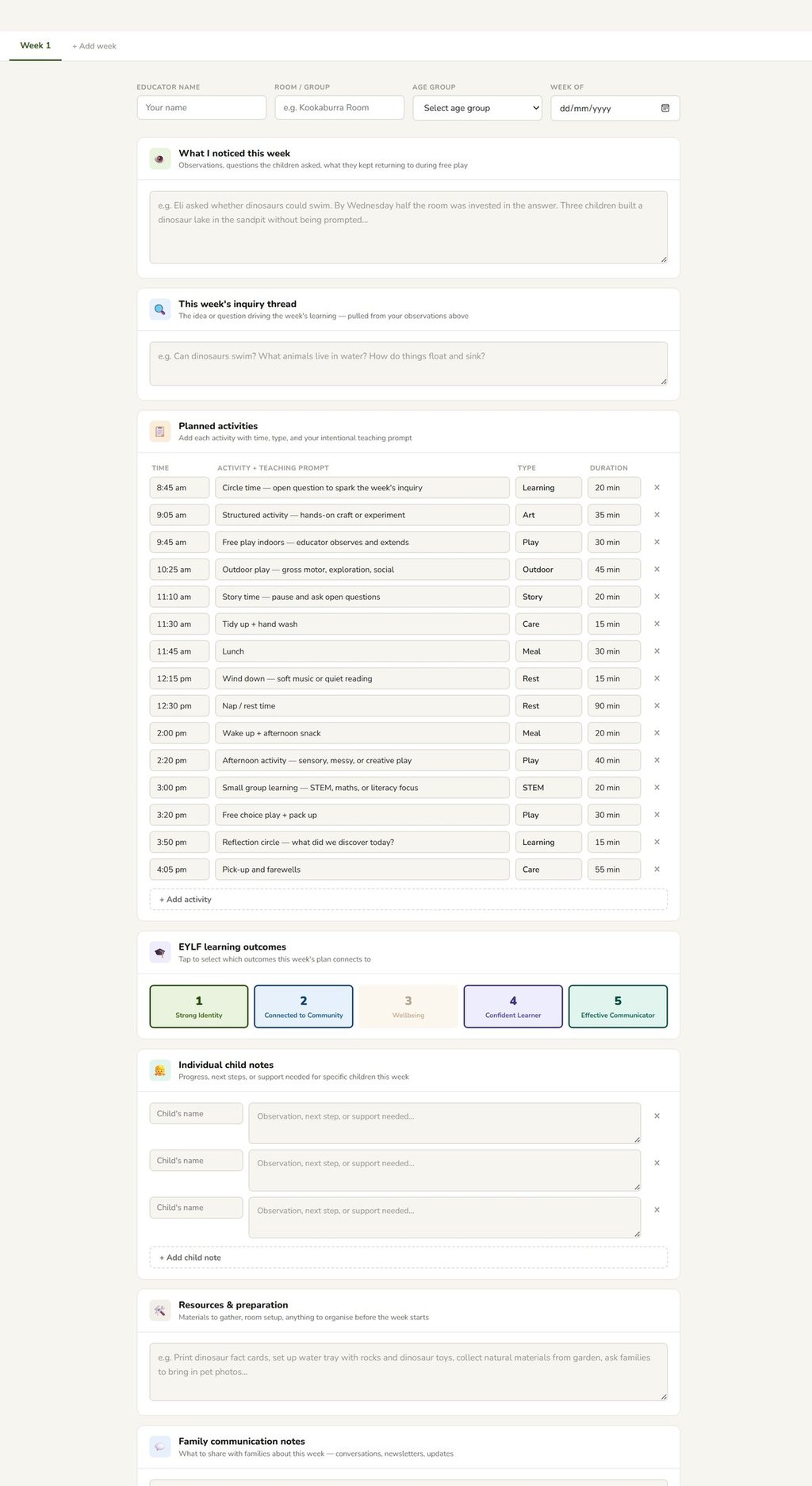
I've made the full week available as a printable so you can keep it on the wall, tuck it into your planner, or hand it to whoever's running the room that day.
Or you can download the file, open it in Chrome or Safari, and start filling it in
References
Malaguzzi, L. (1993). For an education based on relationships. Young Children, 49(1), 9–12.
Vygotsky, L. S. (1978). Mind in society: The development of higher psychological processes. Harvard University Press.
Piaget, J. (1952). The origins of intelligence in children. International Universities Press.
Edwards, C., Gandini, L., & Forman, G. (Eds.). (2012). The hundred languages of children: The Reggio Emilia experience in transformation (3rd ed.). Praeger.
Australian Government Department of Education. (2022). Belonging, being and becoming: The Early Years Learning Framework for Australia (V2.0). Australian Government.
Epstein, A. S. (2007). The intentional teacher: Choosing the best strategies for young children's learning. National Association for the Education of Young Children.
Stacey, S. (2009). Emergent curriculum in early childhood settings: From theory to practice. Redleaf Press.
Buldu, M. (2015). Making learning visible in kindergarten classrooms: Pedagogical documentation as a formative assessment technique. Early Childhood Education Journal, 43(2), 95–103.